Marissa’s adolescence and young adulthood were similar to those of many her age: time spent with friends, going to the movies, and studying for class. She went to college, studied chemistry, started her career, and built a beautiful family with a young son.

But what very few knew was that she was doing all of that while simultaneously managing debilitating symptoms.
The now 31-year-old recalls that symptoms began around age 13 and were associated with her monthly period. With a strong family history of painful cycles and endometriosis, she suspected she had the same condition. But some of her symptoms felt unusual and even scary.
“I started fainting from my symptoms when I was probably 14,” Marissa said. “I remember the first time I was at a mall. I was supposed to be going to a movie with my friend and my mom, and I fainted in the bathroom from pain.”
Searching for Answers
For more than a decade, Marissa suffered without answers. She saw countless doctors who told her that her experience was normal, that her symptoms weren’t severe enough, and who made her feel as though it was all in her head.
“I see the impact of endometriosis in my clinic every single day,” said Dr. Brittany Merrifield, Corewell Health OB/GYN. “I see how it affects their family life, their work life, their self-esteem, and their confidence. It affects their ability to exercise regularly and do other healthy activities. It has a significant impact on a person’s quality of life on a day-to-day basis.”
Marissa says she lives in constant fear, wondering if and when she’s going to faint. She’s afraid it will happen when she isn’t home, when she’s driving, or when she’s holding her young son.
“We’re just expected to live with the pain and symptoms,” she added. “I finally said, ‘I’m done.’”
A Diagnosis That Can Take Years
Endometriosis is a chronic disease that impacts about 190 million people worldwide, which is about 1 in 10 women of reproductive age. It occurs when the lining of the uterus grows in other places, such as the bladder, bowels, and other surfaces throughout the pelvis. Because the tissue is sensitive to hormones, when patients have their monthly period, the lesions react. The result can be chronic pain, debilitating fatigue, generalized inflammation throughout the body, pain with intercourse, and pain with bowel movements.
Getting a diagnosis is another battle. On average, women can see up to 7 healthcare providers about their symptoms before receiving a diagnosis. The World Health Organization says a formal diagnosis takes an average of 4 to 12 years, largely because the symptoms are similar to other illnesses.
Dr. Merrifield said before 2026, the gold standard for diagnosis was laparoscopic surgery, where doctors examined the pelvis for lesions and confirmed the diagnosis through pathology. Current guidelines now say a diagnosis can be made in a doctor’s office based on symptoms, an exam, and an ultrasound. But both options can present challenges.
“While it’s encouraging that patients don’t need to undergo surgery to receive treatment for endometriosis, there’s still a chance you’re treating a patient for a condition they don’t actually have,” Dr. Merrifield adds. “And there can be significant side effects associated with endometriosis medications. This further speaks to the importance of this research and having a non-invasive diagnostic option to ensure we’re selecting the treatments that are most appropriate for each patient.”
Exploring New Methods Through Research
After years of searching, Marissa’s doctor finally scheduled a laparoscopy to confirm her diagnosis. Around that same time, she heard about a clinical trial at BAMF Health for people with endometriosis. She knew right away she wanted to be part of it.
The trial is a collaboration between BAMF Health and Corewell Health, and Dr. Merrifield is one of its principal investigators. The question at its heart is a hopeful one: what if a scan could show where endometriosis is hiding and give patients a definitive diagnosis?
“We’ve identified a protein marker on fibroblast cells that is present on tissues associated with endometriosis,” Dr. Merrifield explains. “There is a PET imaging tracer that, when injected into a patient through an IV, may attach to those proteins and show us if there is tissue outside the uterus where it shouldn’t be.”
Patients like Marissa, who are part of the study, must already have surgery scheduled so researchers can compare surgical and pathological findings with imaging to determine whether they match. If successful, the study could not only lead to a noninvasive diagnosis option for women but also potential treatment options.
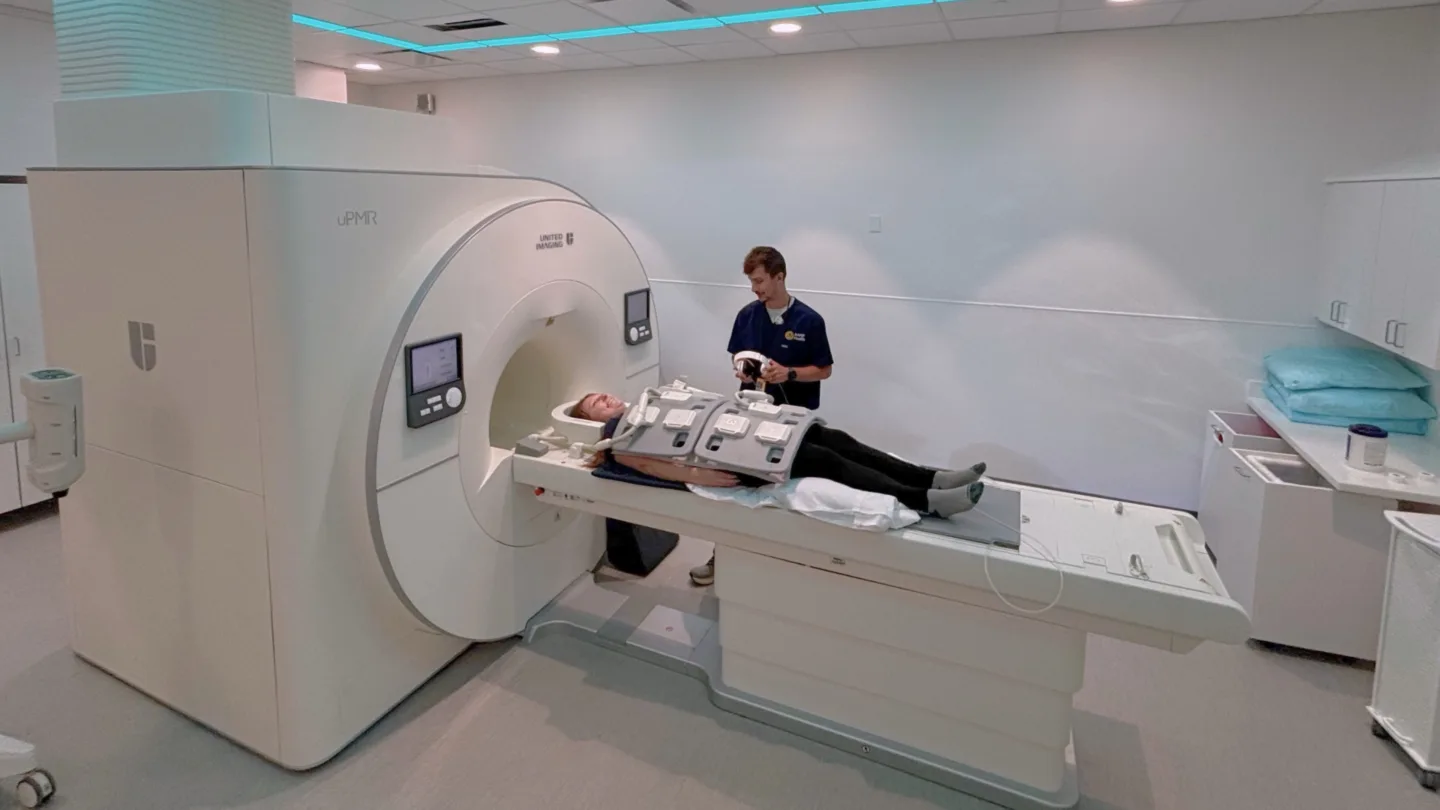
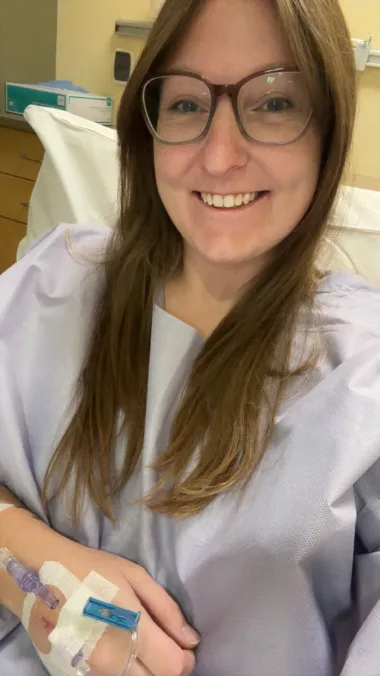
Marissa’s participation in the trial involved an IV injection of the PET tracer and a PET/MR scan at BAMF Health. “There’s no risk of bleeding, no surgery. It’s amazing to use this kind of technology and precision medicine to diagnose disease,” Marissa explained.
“We’ll analyze the images and results from the surgeries to see if we were able to successfully visualize the disease,” said Dan Rogers, BAMF Health’s VP of Clinical Trials. “The results of this study could help spur more investment and development of larger-scale studies to look more closely at the effectiveness of this tracer.”
A Full-Circle Moment
Here’s where Marissa’s story takes a unique turn. Long before this tracer was ever part of her own scan, she had already worked with it.
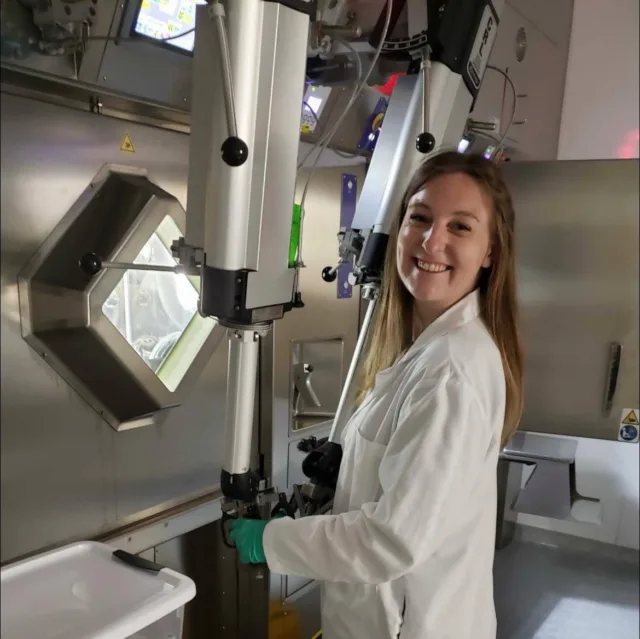
Marissa works in BAMF’s radiopharmacy. “I am on our projects team, so I am responsible for validating all of the new radiopharmaceuticals that come into BAMF for clinical trial use or commercial use,” she said.
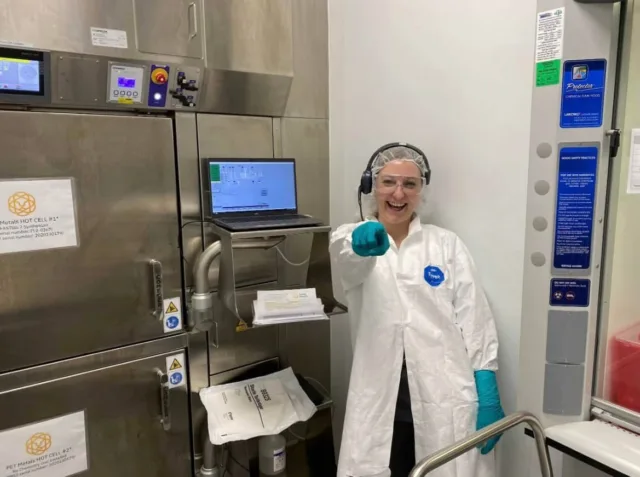
The tracer used in this trial was the very first drug product she ever validated at BAMF.
“It holds a special place in my heart,” she said. “I think it’s absolutely incredible that we can use something as simple as a radiotracer to potentially find endometriosis. We’re doing so many cool things at BAMF that have never been done before, and it is a privilege to be part of it.”
The study is still in its early stages, and answers will take time. But for the millions of women who have been told to simply live with the pain, it offers them a real possibility.
“It’s incredibly exciting,” Rogers emphasized. “You hear Dr. Merrifield share stories about the challenges of living with endometriosis and the struggles women experience in getting a diagnosis. We want to move the science forward and find earlier and better options for them so they can go back to living their lives without pain and other debilitating symptoms.”
For Dr. Merrifield, the goal is clear.
“For me, this is about getting women back to their best quality of life,” she said. “If we can do that faster, with more accuracy and fewer side effects, that’s what research is all about.”
Marissa spent most of her life being told to wait. She’s done waiting. And because of research like this, the next generation of women may not have to wait nearly as long.